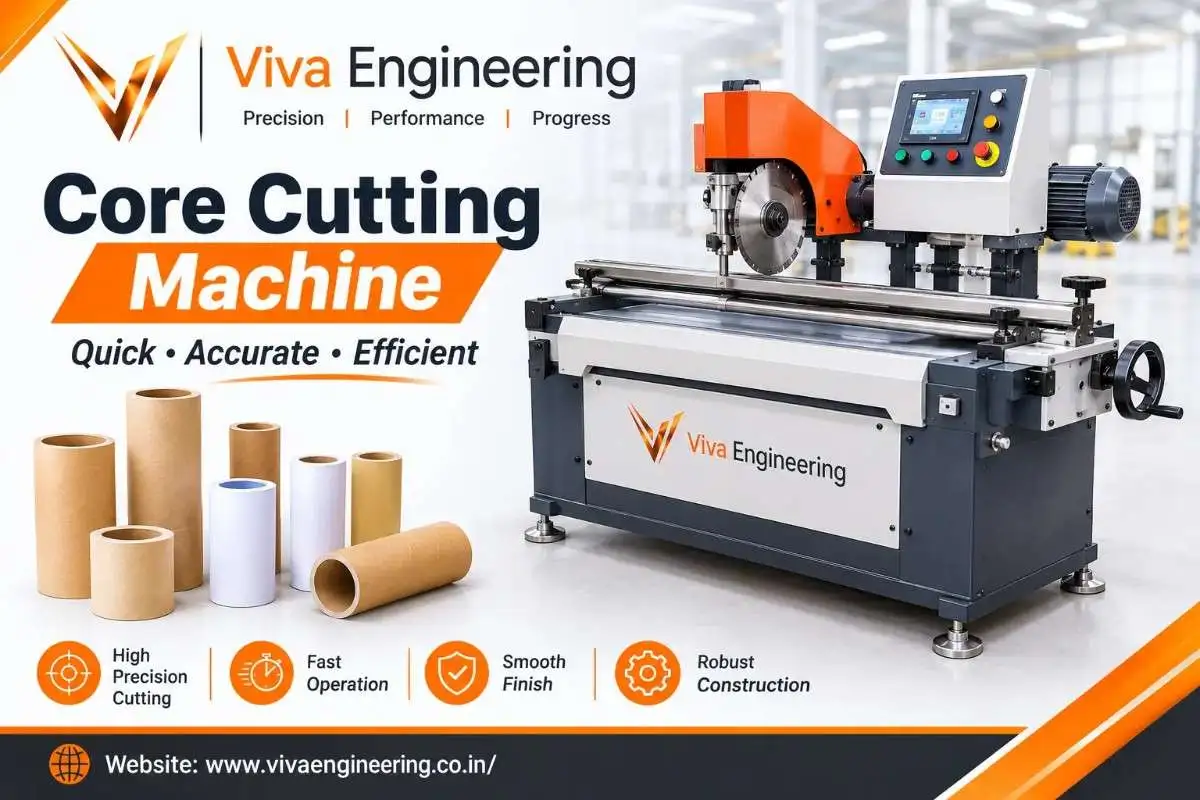
Every finished roll starts and ends with its core. You can slit a jumbo roll with perfect tension and clean edges, but if the cores are uneven, out of round or cut to the wrong length, the roll will wind badly, ship poorly and frustrate your customer. A core cutting machine is the quiet workhorse that prevents this. It turns long cardboard or paper tubes into accurate, ready-to-use cores in the exact length each slit roll needs.
In this guide, we explain why core quality matters, how a core cutting machine pairs with a slitter rewinder machine, which core sizes are common, and how to plan a complete roll finishing line. We also share practical buying tips from our experience at Viva Engineering.
Why Core Quality Matters
Many converters treat cores as a minor consumable. In practice, the core is the foundation of the roll, and small errors there show up as big problems later.
Length accuracy. If a core is cut a few millimetres longer or shorter than the slit width, the roll edge winds unevenly. Overhanging cores get crushed during handling, and short cores let the material telescope or slip at the sides.
Clean, square ends. A ragged or angled cut makes it hard to mount the core on the rewind shaft. It also causes edge damage when the roll is stacked or packed.
Concentricity and round shape. A core that is slightly oval or crushed during cutting makes the roll wobble on the shaft. This leads to tension variation, wrinkles and uneven winding, especially at higher speeds.
Consistent inner diameter. The core must fit your air shaft or mechanical shaft properly. A loose or tight fit affects how well the roll grips during rewinding.
Productivity. Cutting cores by hand or with a basic saw is slow, dusty and inconsistent. A dedicated core cutting machine gives repeatable results shift after shift and frees operators for more valuable work.
For any plant that runs a slitting rewinding machine daily, better cores mean fewer rejected rolls, less material waste and a more professional finished product.
How a Core Cutting Machine Works
A core cutting machine takes long, standard-length tubes, usually paper or cardboard, and cuts them into shorter cores. The basic process is simple:
Loading. The operator places one or more long tubes on the machine bed or feeding rack.
Positioning. The tube is advanced to the required length, set by a stop, scale or digital setting.
Clamping. The tube is held firmly so it does not shift or deform during the cut.
Cutting. A rotating circular blade, or a similar cutting element, slices through the tube wall to produce a clean, square end.
Collecting. The finished cores are collected, ready to be loaded onto the rewind shaft.
Machines vary in how much of this is automatic. A manual or semi-automatic model suits smaller shops with moderate volumes. A fully automatic model feeds, measures and cuts continuously, which makes more sense for high-volume operations. The cutting blade is usually the main wear item, so easy blade access and replacement are worth checking.
How Core Cutters Pair with Slitter Rewinders
A core cutting machine does not work in isolation. Its real value appears when it is matched to the slitting rewinding machine manufacturer’s equipment on your floor.
Here is how the two machines work together in daily production:
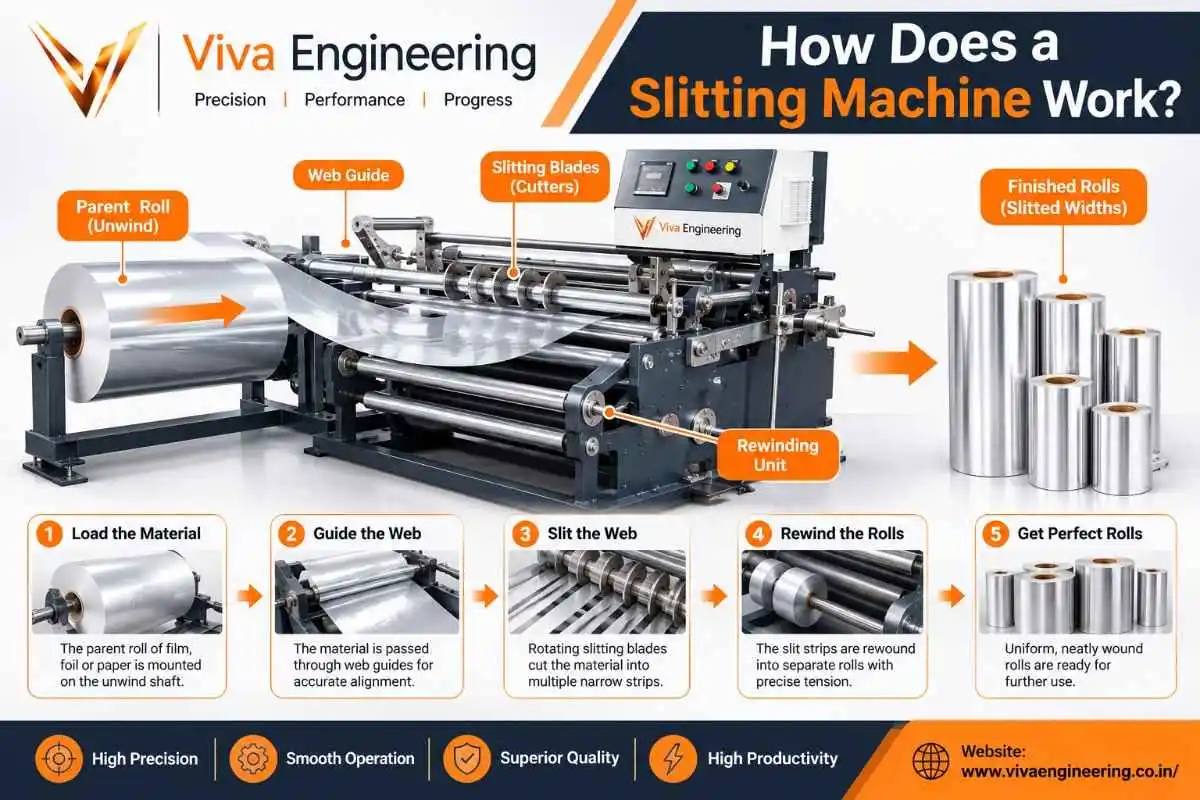
The slitter rewinder unwinds a jumbo roll, slits it into narrower widths using razor, shear or score knives, and rewinds each width onto its own core.
The core cutting machine supplies those cores, each cut to match the slit width exactly.
When your order changes from a 50 mm slit to a 100 mm slit, the core cutter is reset to the new length and your next batch of cores is ready quickly. This is especially useful for converters who handle many small orders, because slit widths change often and you cannot afford to wait on cores.
A paper roll slitter rewinder machine is a common partner for a core cutter, because paper and board converters use large volumes of paper cores. The same principle applies to film, foil, tape and label rolls. Anywhere a roll is wound on a core, the core cutter plays the same supporting role.
It also helps to keep a small buffer of pre-cut cores for your most common widths. Your slitter rewinder then never stops waiting for cores, and your operators can focus on setup and quality checks.
Core Sizes: What to Know
Cores are described mainly by their inner diameter (ID), wall thickness and length. Getting these right is essential for a proper fit on your rewind shafts.
Inner diameter. Common inner diameters in the converting industry include 1 inch, 3 inches and 6 inches, along with metric equivalents such as 25 mm, 76 mm and 152 mm. Your slitter rewinder shaft size decides which one you need. Always confirm the ID before ordering tubes in bulk.
Wall thickness. Thicker walls give more crush resistance and are preferred for heavy rolls such as board, foil or thick film. Thinner walls are fine for light, small-diameter rolls.
Length. This is set by the slit width plus any allowance your process needs. Your core cutting machine should handle the shortest and longest lengths you expect, and it should hold tolerance at both ends of that range.
Material. Paper and cardboard cores are the most common. Some plants also use plastic or composite cores for special applications.
When you evaluate a core cutting machine, ask what range of inner diameters and wall thicknesses it handles, and how quickly you can change from one size to another. A machine that changes over quickly is worth more than one with a slightly lower price but a slow, fiddly setup.
Planning a Complete Roll Finishing Line
A well-planned roll finishing setup considers every step from jumbo roll to packed customer roll. Here is a practical way to think about it.
Step 1: Define your products. List the materials you convert, the slit widths you run and the core sizes your customers expect.
Step 2: Choose the slitter rewinder. Select a slitter rewinder machine with the right web width, speed, tension control and knife system for your material. This is the heart of your line.
Step 3: Match the core cutting machine. Pick a core cutter that covers your core diameters, wall thicknesses and length range, with a throughput that stays ahead of your slitter’s demand.
Step 4: Plan the layout. Place the core cutter close to the slitter rewinder so cores can reach the operator without long carrying. Leave room for storing long tubes and for collecting cut cores.
Step 5: Add finishing and packing. After rewinding, rolls need labelling, wrapping or boxing. Planning this area early keeps your floor organised and your flow smooth.
Step 6: Train operators and set maintenance routines. Simple habits such as blade checks, cleaning dust from the cutting area and verifying core length with a gauge keep quality steady.
Thinking of the core cutter and slitter rewinder as one connected system, rather than two separate purchases, leads to a smoother, more efficient plant.
Buying Tips for a Core Cutting Machine
Before you decide, work through these points:
Check capacity. Confirm the minimum and maximum core diameter, wall thickness and length the machine can handle.
Ask about cut quality. Request samples or a demonstration, and inspect the ends for squareness and the absence of burrs or crushing.
Look at changeover time. Frequent size changes make quick adjustment a real productivity gain.
Consider automation level. Match manual, semi-automatic or automatic operation to your daily volume and labour availability.
Review blade life and replacement. Ask how often blades need changing and how easy the replacement is.
Think about dust and safety. Good guarding and a practical dust collection arrangement protect operators and keep the floor clean.
Plan for the future. If you may add new materials or larger rolls, choose a machine with some headroom.
Choose a supplier who supports the whole line. A manufacturer that understands both core cutting and slitting rewinding can advise on how the machines work together, and can provide spares and service when you need them.
Build Your Roll Finishing Line with Viva Engineering
At Viva Engineering, we design and manufacture machinery for roll converting, and we understand how each machine on the line affects the next. If you are adding a core cutter or upgrading your slitter rewinder, our team can help you choose a setup that fits your materials, widths and output targets.
Explore our core cutting machine to see specifications and options, or contact us with your requirements for a tailored recommendation.