Paper, film, foil, labels and non-woven fabric are all made in very wide rolls. Factories produce them this way because it is efficient. But customers rarely want a roll two metres wide. They want narrow rolls of specific widths, such as 50 mm for tape, 300 mm for a printing press or 1,000 mm for a packaging line.
The machine that bridges this gap is the slitting machine. If you have ever wondered how does a slitting machine work, this guide walks through the full process, from loading the jumbo roll to collecting the finished rolls. It also covers the parts of the machine, the knife types, and the common defects you should know how to fix.
What Is a Slitting Machine?
A slitting machine, usually called a slitting rewinding machine, cuts a wide roll of material lengthwise into several narrower rolls and winds each one onto its own core. The wide roll is called the jumbo roll or parent roll. The narrow rolls are called daughter rolls or slit rolls.
The same basic idea applies whether the material is paper, plastic film, aluminium foil, laminates, labels or textiles. What changes is the knife type, the tension range and the machine’s strength.
The Main Parts of a Slitting Machine
Before the step-by-step process, it helps to know the key sections of the machine.
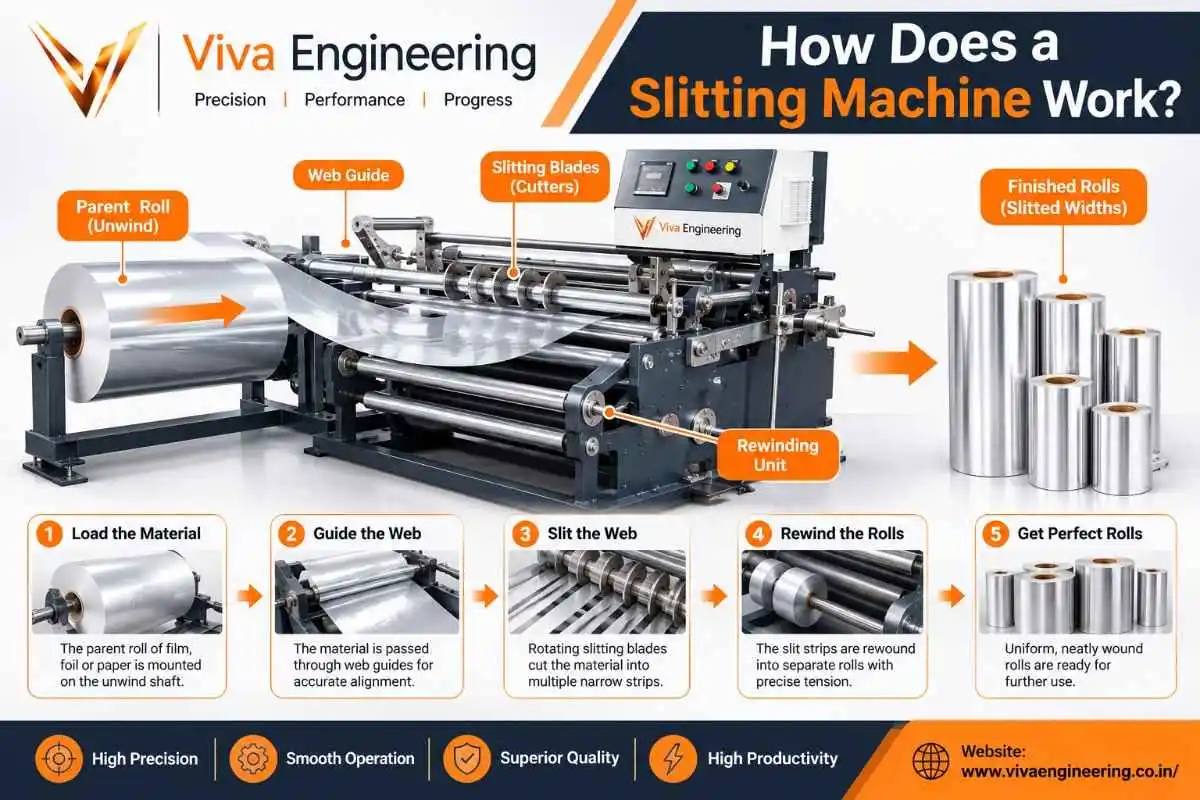
Unwind stand: Holds the jumbo roll and feeds the material into the machine.
Web guide: Keeps the material centred and straight as it travels.
Tension control system: Maintains steady pull on the material through the machine.
Slitting section: Holds the knives that cut the material to width.
Rewind shafts: Wind the slit material onto cores.
Drive and control panel: Sets speed, tension and length, often with a PLC or touchscreen.
A modern jumbo paper roll slitter rewinder machine may also include edge trim removal, a length counter and an automatic roll unloader.
Step 1: Unwinding the Jumbo Roll
The process starts at the unwind stand. The operator lifts the jumbo roll onto the machine, usually with a hoist, and locks it onto a shaft or between chucks. Larger machines use hydraulic or pneumatic lifting to load heavy rolls safely.
Once the roll is mounted, the operator threads the leading edge of the material through the machine, over the guide rollers and toward the slitting section.
The unwind section does two important jobs:
It lets the roll rotate smoothly without wobbling.
It applies controlled braking so the roll does not over-spin or sag.
Many machines use a pneumatic or magnetic powder brake on the unwind shaft. This brake resists the pull of the machine and creates the base tension for the whole process.
Step 2: Web Guiding and Alignment
A wide roll rarely feeds in perfectly straight. Small variations in how it was wound can make the edge drift left or right.
A web guide system corrects this. A sensor detects the edge of the material and a small actuator moves the unwind or a guide roller to bring the web back to centre. Good web guiding keeps slit widths accurate and prevents the edges of the daughter rolls from being uneven.
Step 3: Tension Control
Tension is the pull applied to the material as it moves through the machine. It is the most important variable in any slitting process.
Too little tension: The material wrinkles, wanders or winds into soft rolls that telescope.
Too much tension: The material stretches, necks in or tears, and rolls can crush their cores.
Different materials need different tension. Thin plastic film needs low, precise tension. Paperboard can handle higher tension. Foil needs careful control to avoid breaks.
Modern machines use a load cell or dancer roller to measure tension continuously. The control system adjusts the unwind brake and the rewind torque automatically, so tension stays steady even as the roll diameter changes. This is a major reason why a good roll slitter rewinder machine produces better rolls than a basic one.
Step 4: Slitting the Web with Knives
After tensioning, the material reaches the slitting section. Here knives cut it into strips. The knife type depends on the material and the quality you need.
Razor Blade Slitting
Thin razor blades cut the web against a smooth roller or in the air. This is the simplest and cheapest method.
Best for: thin plastic films, light papers, tapes
Advantages: low cost, easy to set up, quick blade changes
Limits: blades wear fast and not suited to thick or abrasive materials
Shear Slitting
Shear slitting uses a pair of circular knives, one on top and one on the bottom. They overlap slightly and cut like a pair of scissors.
Best for: paper, board, foil, laminates, non-woven fabric
Advantages: clean, dust-free edges and long knife life
Limits: needs careful setting of overlap and pressure
Score (Crush) Slitting
In score slitting, a sharp circular knife presses against a hard anvil roller. The material is cut by pressure at a single point.
Best for: thicker materials, some papers and laminates, adhesive-backed materials
Advantages: simple and works on thick or soft products
Limits: can leave a slightly rougher edge and the anvil wears over time
Choosing the right knife type is one of the biggest factors in edge quality. A reliable manufacturer will help you pick the right method for your material.
Step 5: Setting the Slit Widths
Before the run begins, the operator positions the knives across the width to match the order. Basic machines use manual knife holders that slide along a bar. More advanced machines use motorised knife positioning that sets all knives automatically from a stored recipe.
Accurate knife placement matters because even a small error becomes a rejected roll. Most machines include a measuring scale or digital readout to help the operator set widths precisely. Edge trim, the waste strip on each side, is removed by a vacuum or a rewound trim shaft.
Step 6: Rewinding the Slit Rolls
After slitting, each narrow strip must be wound onto a core. This is the rewinding stage, and it decides how good the finished rolls look and feel.
There are two common rewind setups.
Single shaft rewinding: All slit strips wind on one shaft. It works for wider slits and simple jobs.
Differential shaft or two-shaft rewinding: Strips are alternated between a top and bottom shaft. This gives each roll space to wind cleanly and prevents neighbouring rolls from rubbing.
Each roll is wound with a controlled torque. As the diameter grows, the system reduces the pull so the roll stays firm without crushing the inner layers. Many machines use a lay-on roller to press air out as the roll winds and give a tight, even surface.
Once the target length or diameter is reached, the machine slows and stops. The operator removes the rewind shafts, slides off the finished rolls, labels them and prepares the next batch.
Step 7: Inspection and Packing
The last step is checking the finished rolls. The operator looks for:
Straight, clean edges
Correct width
Even, firm winding
No visible damage, wrinkles or creases
Rolls that pass are packed, labelled and sent to the customer or the next process.
Common Slitting Defects and How to Fix Them
Even a good machine can produce defects when settings are not right. These are the most common problems.
Telescoping rolls. The core slides out as if the roll were a telescope. This usually means winding tension is too low or the roll was wound too fast. Raise the rewind tension or reduce the speed.
Wrinkles and creases. These come from uneven tension across the width, a misaligned roller or a poorly guided web. Check roller alignment and web guide settings.
Dust and edge debris. Dull or badly set knives crush instead of cut, which creates dust. Replace or sharpen the knives and check the overlap and pressure.
Burrs or rough edges. Often caused by worn blades or incorrect knife angle. Change the blades and review your knife type.
Wandering web. The material drifts left or right during the run. Look at the web guide sensor, roller parallelism and unwind alignment.
Hard or crushed rolls. Too much torque or lay-on pressure. Reduce winding tension, especially near the end of the roll.
Uneven roll edges. Typically from poor knife positioning or a worn shaft. Recheck the slit widths and shaft condition.
A short checklist at the start of every job, covering knife condition, tension setting, roller cleanliness and web alignment, prevents most of these problems.
How to Choose a Slitting Rewinding Machine
If you are planning to buy a machine, consider these points.
Material type: Paper, film, foil, label stock or laminate each have different needs.
Jumbo roll width and diameter: Match the machine to your largest roll.
Slit width range: Confirm the smallest and largest widths required.
Speed and output: Ask for realistic production numbers, not only the maximum speed.
Knife system: Choose razor, shear or score according to your material.
Automation level: Decide between manual, semi-automatic or fully automatic.
Service and spares: Check that the manufacturer supports you after delivery.
Working with an experienced manufacturer of slitting rewinding machines helps you avoid paying for features you do not need or missing ones that you do.
Maintenance Tips for Smooth Slitting
Keep knives sharp and replace them on schedule
Clean rollers, shafts and sensors regularly
Lubricate bearings and moving parts as recommended
Check brakes, clutches and tension devices periodically
Calibrate load cells and sensors at set intervals
Regular care extends the machine’s life and keeps roll quality consistent.
Explore Slitting Machines from Viva Engineering
Viva Engineering, based in Ahmedabad, manufactures slitting and rewinding machines for paper, film, foil and other converting materials. Each machine is built around the customer’s roll size, material and output target. You can see the available models and specifications on the paper slitting rewinding machines page.
Conclusion
So, how does a slitting machine work? It unwinds a jumbo roll under controlled braking, keeps the web straight with a guide, holds steady tension, cuts the material with razor, shear or score knives, and winds each narrow strip onto its own core. Every stage affects the final result, which is why tension control, knife choice and rewinding quality matter so much.
If you are planning a new slitting line or upgrading an old one, talk to Viva Engineering with your material, roll size and production target, and get a machine matched to your needs.